“All my writing, and yours, is autobiographical….We become what we write. That is one of the great magics of writing.” (Donal Murray, “All Writing Is Autobiography,” pp. 66 & 71)
Chapter 2 Required Materials and Tasks
Chapter 2 Required Readings: Writing Process Theory/Expressivism (1970s)
- “Freewriting Exercises” by Peter Elbow
- Writing without Teachers. New York: Oxford UP, 1973. 3-11.
- “All Writing Is Autobiography” by Donald M. Murray
- College Composition and Communication, Vol. 42, No. 1. (Feb., 1991), pp. 66-74.
- Expressivist Composition Pedagogy by Peter Anderson
- “Teach Writing as a Process Not Product” by Donald Murray
- The Leaflet (November 1972): 11-14
- “Engfish” by Ken Macrorie
- Uptaught. New York: Hayden Book Co, 1970. 9-18.
- “The Poison Fish” by Ken Macrorie
- Telling Writing, 4th ed., 1985
Chapter 2 Discussion Questions
-
- Should writing help the writer to grow?
- Should writing help the writer to develop an individual voice?
- Should writing be free of academic constraints?
- Should writing foster the writer’s creative development?
- How do we deal with the imagined teacher inside students’ heads?
Chapter 2 Class Activities
The Power of Freewriting (Elbow, 1973)
- Poem: First Day by Gian Pagnucci
- A poem about starting college life by Gian S. Pagnucci
- Distributed in 2012 to all of IUP’s first year students
- Music: Motzart
- Freewrite
- Discussion Questions
- What did you write about?
- Was there anything good in there?
- Consider the question of having no topic versus a focused freewriting topic. What are the advantages/disadvantages of each approach?
- Look for anything in your freewriting that gives a sense of “voice.” What helps you identify examples of voice in your writing?
- How can we help students develop their “voice?”
The Harvard Composition Program (1875)
- “Introduction” by John C. Brereton
- The Origins of Composition Studies in the American College, 1875–1925: A Documentary History. University of Pittsburgh Press. (1995).
- The rise of the American university
- German model: specialization
- Expansion of knowledge: science (made rhetoric seem obsolete)
- Increase in enrollments
- Effort to change American higher education
- The Birth of the Modern Composition Program
- Established in 1869 by Harvard President Charles W. Elliot
- Harvard, the most important American University in the U.S.
- Elevated English, both writing and literature, to a level of importance equal to mathematics and the classics
- Established a placement examination in composition
- Shift from required courses to electives meant writing had to be taught in 1 early class rather than every year
- English A: course in rhetoric and writing
- Students developed their own topics
- No use of readings beyond the textbook; very little emphasis on reading in general
- No literature used
- English 12: Daily Themes
- Problems
- Some faculty asked not to have to grade themes when they were hired
- No development of a research program in rhetoric
- Highly authoritarian model
- The paper load and relentless correction of student errors created a kind of teacher slavery
Current Traditionalism
- Emerges from the Harvard model
- Teacher has authority
- The focus is on grammatical correctness
- Most widely used approach to teaching writing
- How the general public views the purpose of writing instruction
- The Traditional Approach vs. The Process Approach
Classical Rhetoric
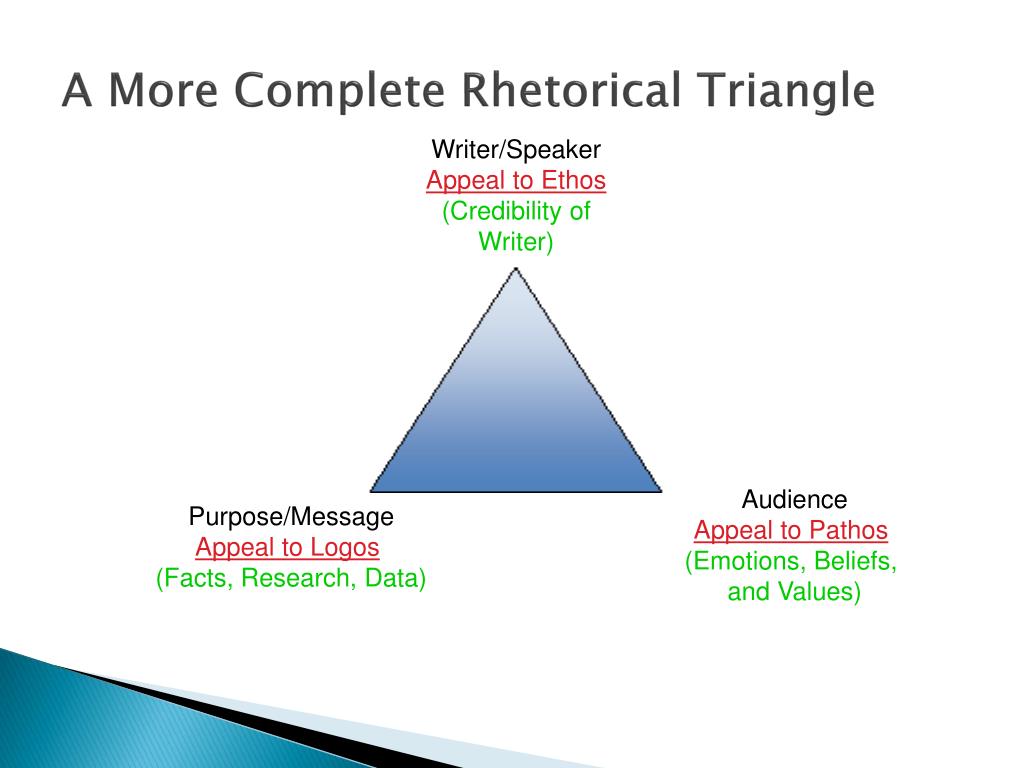
- The Rhetorical Triangle
- Ethos (credibility): Speaker/Writer
- Pathos (empathy/emotion): Audience/Reader
- Logos (logic): Message/Text
- The Rhetorical Modes
- The 4 Most Commonly Taught Rhetorical Modes:
- Description
- Narration
- Exposition
- Persuasion
- Rhetorical Strategies
- Cause/Effect
- Classification/Division
- Comparison/Contrast
- Definition
- Explanation of a Process
- Use of an Example/Illustration/Analogy
- Unfortunately, the Classical Rhetoric approach was often taught in a decontextualized way with the categories rigidly adhered to; rather than discuss the overlap of, say, narration and persuasion, each form was typically taught in isolation
The Writing Process (1972)
- “Teach Writing as a Process Not Product” by Donald Murray
- The Leaflet (November 1972): 11-14
- Core Implications of Teaching Writing Process:
- The text of the course is the student’s own writing.
- The students finds his [or her] own subject.
- The student uses [her or] his own language.
- The student may write as many drafts as necessary.
- The student may write in any form.
- Mechanics come last.
- The writer needs both unpressured time and a deadline.
- A grade finishes a paper the way publication does.
- Each student write must explore the writing process individually.
- “There are no rules…All writing is experimental” (p. 5).
- “What is the process we should teach? It is the process of discovery through language. It is the process of exploration of what we know and what we feel about what we know through language. It is the process of using language to learn about our world, to evaluate what we learn about our world, to communicate what we learn about our world” (p. 4).
- “Instead of teaching finished writing, we should teach unfinished writing, and glory in its unfinishedness.” (p.4)
- “The writing process itself can be divided into three stages: prewriting, writing, and rewriting” (p. 4).
- As the teacher, “we have to be quiet, to listen, to respond. We are not the initiator or the motivator; we are the reader, the recipient” (p. 5).
- “We must listen carefully for those words that may reveal a truth, that may reveal a voice” (p. 5).
- “All Writing Is Autobiography” by Donald M. Murray
- College Composition and Communication, Vol. 42, No. 1. (Feb., 1991), pp. 66-74.
Expressivism (1970s)
- The Turn to Expressivism
- Veterans of the Vietnam War go to college thanks to the G.I. Bill
- Teachers try to give them meaningful writing experiences
- Expressivist Composition Pedagogy by Peter Anderson
- Peter Elbow: Writing Without Teachers (1973)
- “Freewriting Exercises” by Peter Elbow
- Writing without Teachers. New York: Oxford UP, 1973. 3-11.
- “The most effective way I know to improve your writing is to do freewriting exercises regularly. At least three times a week. They are sometimes called ‘automatic writing,’ ‘babbling,’ or ‘jabbering’ exercises. The idea is simply to write for ten minutes (later on, perhaps fifteen or twenty). Don’t stop for anything. Go quickly without rushing. Never stop to look back, to cross something out, to wonder how to spell something, to wonder what word or thought to use, or to think about what you are doing. If you can’t think of a word or a spelling, just use a squiggle or else write ‘I can’t think what to say, I can’t think what to say’ as many times as you want; or repeat the last word you wrote over and over again; or anything else. The only requirement is that you never stop” (p. 3)
- “What happens to a freewriting exercise is important. It must be a piece of writing which, even if someone else reads it, doesn’t send any ripples back to you. It is like writing something and putting it in a bottle in the sea…Freewritings help you by providing no feedback at all. When I assign one, I invite the writer to let me read it, but also tell him to keep it if he prefers” (pp. 3-4).
- See Neil Gaiman: Send writing out in bottles and see if anyone sends the bottle back.
- “Writing has the advantage of permitting more editing. But that’s its downfall too. Almost everyone interposes a massive and complicated series of editings between the time the words start to be born into consciousness and when they finally come off the end of the pencil or typewriter onto the page. This is partly because schooling makes us obsessed with the ‘mistakes’ we make in writing. Many people constantly think about spelling and grammar as they try to write. I am always thinking about the awkwardness, wordiness, and general mushiness of my natural verbal product as I try to write down words” (pp. 4-5).
- “But it’s not just ‘mistakes’ or ‘bad writing’ we edit as we write. We also edit unacceptable thoughts and feelings, as we do in speaking” (p. 5)
- “The habit of compulsive, premature editing doesn’t just make writing hard. It also makes writing dead. Your voice is damped out by all the interruptions, changes, and hesitations between the consciousness and the page. In your natural way of producing words there is a sound, a texture, a rhythm–a voice–which is the main source of power in your writing. I don’t know how it works, but this voice is the force that will make a reader listen to you. Maybe you don’t like your voice; maybe people have made fun of it. But it’s the only voice you’ve got. It’s your only source of power” (pp. 6-7)
- Ken Macrorie: Uptaught (1970) and Telling Writing (1985)
- “Engfish” by Ken Macrorie
- Uptaught. New York: Hayden Book Co, 1970. 9-18.
- “I should have realized that a cataclysmic event was needed to break a student away from the dead language of the schools–some severe displacement or removal from the unreal world of the university, like drunkenness. But I didn’t. I was beginning my teaching, and naturally enough, developing a protective blindness” (p. 11).
- “But the troops weren’t performing their job, which was to write clearly and powerfully in my classe. I thought that was their fault” (p. 11).
- “I tried to get my students to write like that–as if they were on fire about something–but they kept turning out phony paragraphs” (p. 11).
- (See Claude Mark Hurlbert: “What are you burning to tell the world?”)
- “I learned how to correct papers, not read them” (p. 12).
- “I began to notice hundreds of signs suggesting that most English professors despised their students’ work. They should have. It was usually terrible” (p. 16).
- “The Poison Fish” by Ken Macrorie
- Telling Writing, 4th ed., 1985
- “he knew the girl had found a name for the phony, pretentious language of the schools—Engfish”
- “Most English teachers have been trained to correct students’ writing, not to read it; so they put down those bloody correction marks in the margins. When the students see them, they think they mean the teacher doesn’t care what students write, only how they punctuate and spell. So they give him Engfish. He calls the assignments by their traditional names— themes. The students know theme writers seldom put down anything that counts for them. No one outside school ever writes anything called themes. Apparently they are teacher’s exercises, not really a kind of communication”
- “Another kind of Engfish—not fancy, academic language, but simply everyday words that say nothing because they keep all the girl’s experience private. Anyone else reading that entry would forget it instantly because neither the writer nor the person written about come alive. A year later the sentence would mean almost nothing even to the writer”
- The I-Search Paper
- Meaningful research paper approach taught by Ken Macrorie
- What are you burning to tell the world?
- IUP CAL Emeritus Professor Claude Mark Hurlbert
Chapter 2 Optional Materials
Other Important Process Articles
- “Process Pedagogy” by Lad Tobin: Tate, G., Taggart, A. R., Schick, K., & Hessler, H. B. (2014). A Guide to Composition Pedagogies. New York: Oxford University Press, 1-18.
- “On Students’ Rights to Their Own Texts: A Model of Teacher Response” by Lil Brannon and C. H. Knoblauch (Requires login via IUP account)
- College Composition and Communication
Vol. 33, No. 2 (May, 1982), pp. 157-166
- College Composition and Communication
- Donald Graves: Writing: Teachers and Children At Work
Contemporary Expressivism