Unit 2 Required Materials
Due Sep. 9 Monday: Required Reading on Managing Knowledge & Information
- Tiago Forte’s Building a Second Brain

- Read enough so that you can discuss Forte’s basic ideas
- It’s not necessary to finish the book
- Forte Labs
Begin Class Part 1 @ 5:00 p.m.
Chapter 7 Class Activities
Part 1. Lecture (10 minutes)
Information Overload (Forte, pp. 17-18)
-
- People consume 174 newspapers per day (New York Times)
- According to a People spend 76 hours per year looking for misplaced notes, items, and files (based on research by Microsoft)
- 26% of workers’ time is spent looking for and consolidating information(based on research by Microsoft)(based on research by Microsoft)
- Workers are successful at doing this only 56% of the time (based on research by Microsoft)
- Human brains aren’t built for storing and retrieving information, they are built for creativity!
The Superpowers of the Second Brain (Forte, p. 34)
-
- Making our ideas concrete
- Revealing new associations between ideas
- Incubating our ideas over
- Sharpening our unique perspectives
Personal Knowledge Management (Forte, p. 40)
-
- Remembering
- Connecting
- Creating
CODE (Forte, p. 43)
-
- Capture–Keep what resonates
- Organize–Save for actionability
- Distill–Find the essence
- Express–Show your work
Capture What Resonates (Forte, pp. 68-69)
-
- Criteria 1: Does it inspire me?
- Criteria 2: Is it useful?
- Criteria 3: Is it personal?
- Criteria 4: Is it surprising?
Part 2: Capturing Ideas (15 minutes)
- Take 10 minutes to read this article
- Take notes as you read following Forte’s method
Part 3: Productivity Potential Quiz (10 minutes)
- Forte has developed a productivity quiz
- Who can pass up an Internet quiz?
- And it only takes 7 minutes, so why not, right? (And we wonder why our productivity goes down so quickly?)
- Productivity Potential Quiz
Part 4: Small Group Discussion–Teaching Students How to Manage Information (25 minutes)
- Discuss your note taking (10 minutes)
- Then discuss the following questions (15 minutes)
- Discuss the general problem of information overload as it applies to students in the broad field of English studies
- How can we prepare students to deal with information overload?
- What skills do our students need to learn about managing information and how can we teach them these skills?
- What do you think of the idea of teaching students to be Knowledge Managers?
Part 5: Large Group Discussion–Teaching Students How to Manage Information (30 minutes)
From “Death by Information Overload”
- “…a survey of 2,300 Intel employees revealed that people judge nearly one-third of the messages they receive to be unnecessary. Given that those same employees spend about two hours a day processing e-mail (employees surveyed received an average of 350 messages a week, executives up to 300 a day), a serious amount of time is clearly being wasted.”
- “A study by Microsoft researchers tracking the e-mail habits of coworkers found that once their work had been interrupted by an e-mail notification, people took, on average, 24 minutes to return to the suspended task.”
- “The scenario the researchers described was unsettlingly familiar. Dealing with the message that had prompted the alert represented only a portion of the time off task. People often used the interruption as an opportunity to read other unopened e-mail messages—or to engage in such unrelated activities as text-messaging a friend or surfing the web. Surprisingly, more than half the time was spent after people were ready to return to their work: cycling through open applications on their computers to determine what they’d been doing when interrupted; getting distracted by some other work in progress as they moved from one window to another; and reestablishing their state of mind once they finally arrived at the application they’d abandoned nearly a half hour earlier.”
Part 6. Break (10 minutes)
End Class Part 1 @ 7:00 p.m.
Begin Class Part 2 @ 7:00 p.m.
Part 7: Lecture (5 minutes)
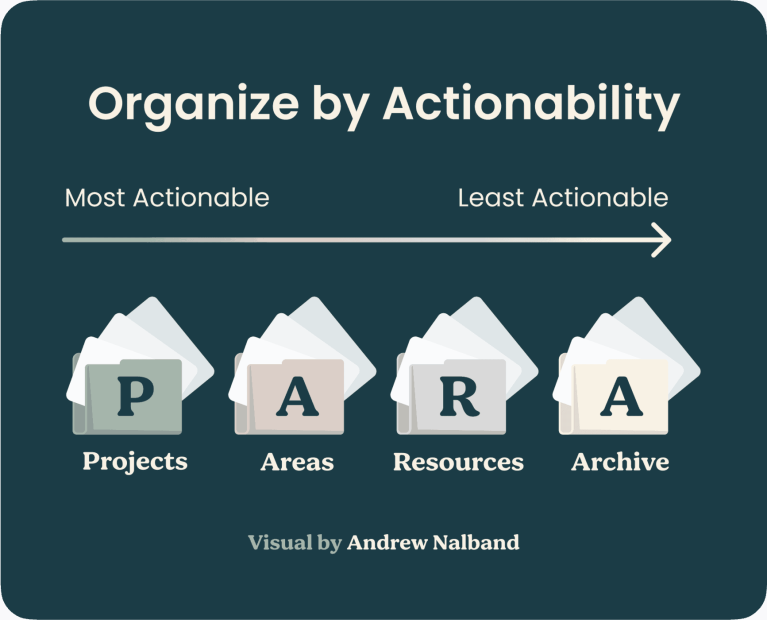
- PARA (Forte, p. 90)
- Projects: Short-term efforts (in your work or personal life) that you take on with a certain goal in mind
- Areas: Long-term responsibilities you want to manage over time
- Resources: Topics or interests that may be useful in the future
- Archive: Inactive items from the other 3 categories
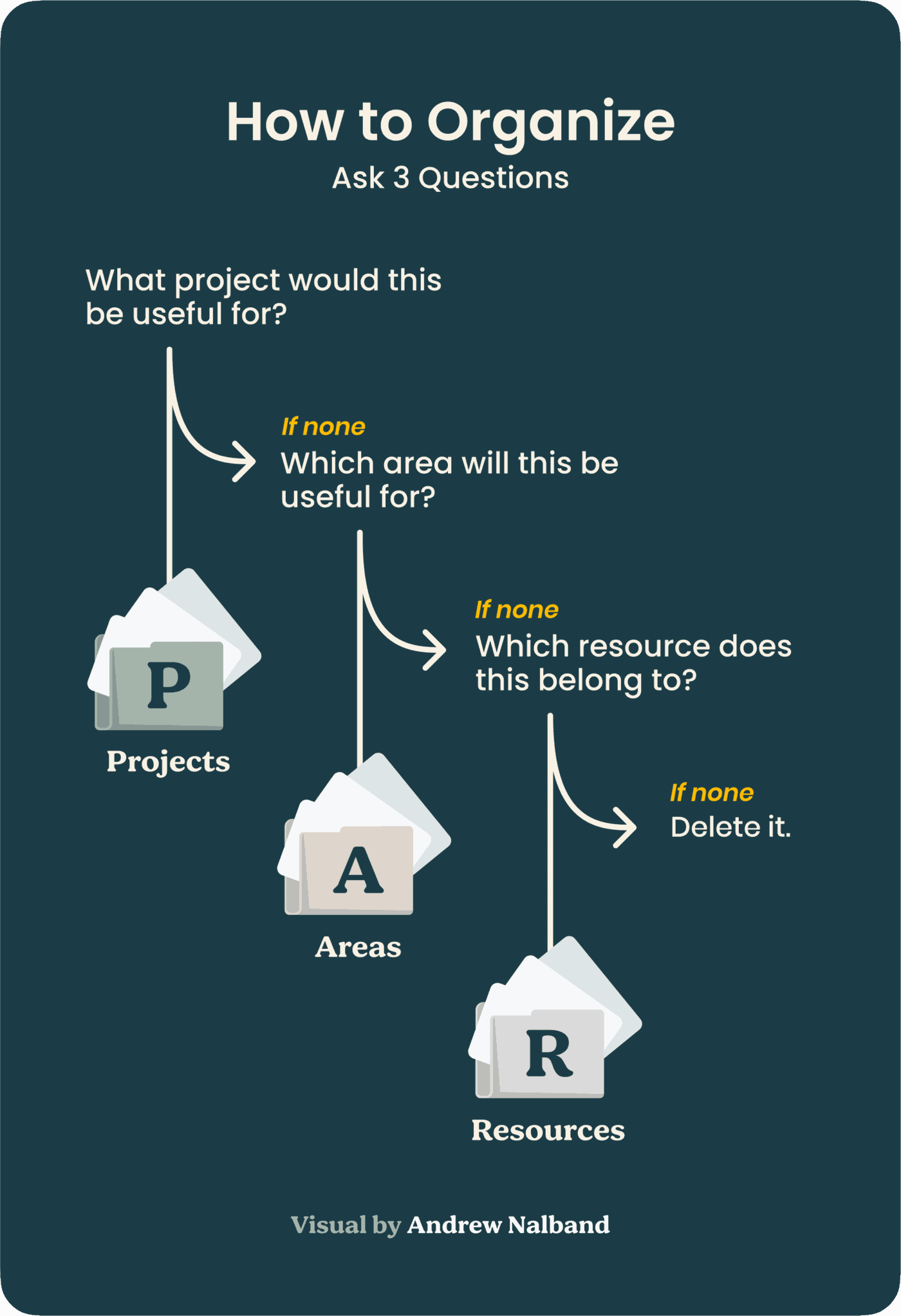
- How to use PARA to organize
- Move all existing files to a folder titled Archive with today’s date!
- This gives you a clean slate
- Place items in a holding area (like your Downloads folder)
- File quickly once per week using the PARA system
Part 8: Free Writing (15 minutes)
- Create a list of your projects, areas, and resources
Part 9: Free Writing (10 minutes)
- Create an Intermediate Packet/Building Block for your Dissertation
Part 10: Small Group Discussion (10 minutes)
- Talk about your Intermediate Packet for your dissertation
Part 11: Full Class Discussion (10 minutes)
- Final Thoughts on Forte
Part 12: Assignments Review & Class Wrap-up (5 minutes)
- Review Assignments listed below
Assignments
Due Week 4 (Sep. 16): Required Readings and Materials on Managing Time, Stress, & Your Life
- Video: Google TechTalk by Inbox Zero Founder Merlin Mann (58:41)
- This video is about an hour long, but it is exceptionally good, even the very end where Merlin starts doing Q&A (in fact, that Q&A actually includes one of the most important points of the whole video, so you don’t want to quit too soon)
- Even if you know about Inbox Zero or have seen the video before, it’s really worth watching it again; I try to watch it every year or two because it helps inspire me to try to get back on track with my email
- I hope you’ll enjoy it
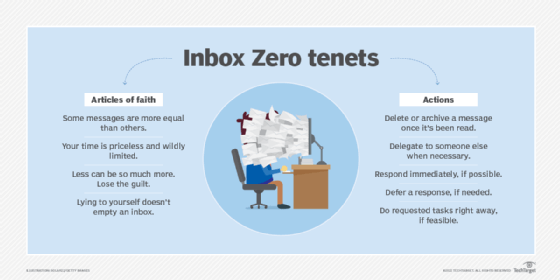
- Inbox Zero
- This is a website about how to better manage email
- Getting Things Done: The Art of Stress Free Productivity (GTD)
- David Allen’s seminal work on time management

- Read enough of the book (a good chunk) so that you can discuss Allen’s basic ideas
- It’s not necessary to finish the book, but this GTD book could just change your life!
- Article: “Do You Really Not Have the Time?” by David Perlmutter
- Chronicle of Higher Education article on time management
- The Peak Time for Everything
- Wall Street Journal article