Comic books have been enjoyed around the world for nearly 100 years now, but the started as a uniquely American invention. The first superhero, Superman, was introduced in Action Comics #1. Superman was born on another world called Krypton. As a baby he was sent in a rocket to earth by his parents right before his home world exploded. Because of his Kryptonian physiology the earth’s yellow sun gave Superman incredible powers, and he chose to use those powers to fight evil. This is the first superhero origin story which explains how Superman got his powers.
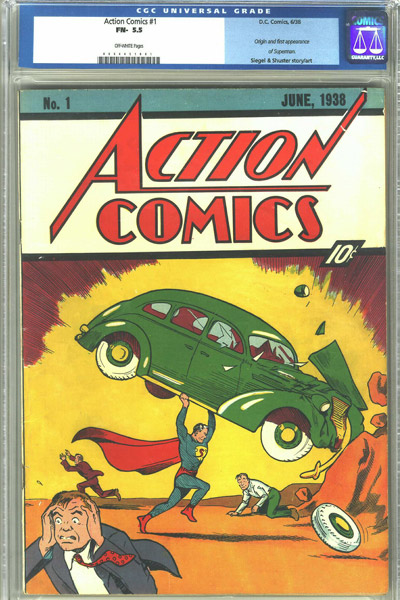
Superman was created by Jerry Siegel (writer) and Joe Shuster (artist) in 1938, only a few years after the Great Depression in America had ended. Superhero comic books have always been created collaboratively by teams of writers and artists working together.
Although Superman was the first superhero, he followed in a long tradition of heroes who had extraordinary powers. Hercules, Achilles, the Amazons, and the mighty Samson are all examples of legendary characters who had amazing abilities. Jesus is also an example of a being who has been described as having special powers, such as the abilities to heal people and to walk on water.
It is highly significant that throughout history, when writers and storytellers have imagined people with super powers, they have consistently imagined those super powers being used to do good. Supervillains and evil doers do show up, but we start with superheroes not supervillains. One might argue, then, that goodness is innate, that it is at the heart of how we see ourselves. We imagine ourselves to be good and noble, and so we assume, or at least hope, that if a person were to gain superpowers, the person would try to use those powers to do good. The fundamental message of superhero stories is that humans are good, we are meant to strive to do good, and doing good matters. In the world of superheroes, good always triumphs over evil because it’s just supposed to be that way.
“Superhero stories and characters have withstood the test of time…As much as these characters may be all powerful, they’re simultaneously representative of the common person and all that person stands for in a world that can be inherently corrupt and dangerous. The fact that superheroes are fictitious does little to diminish their significance since nearly all superheroes’ origins are grounded in humble beginnings with normal people doing great and noble feats with the powers they’ve gained” (Romagnoli and Pagnucci, 2013, p. 5).

–Romagnoli, A., & Pagnucci, G. S. (2013). Enter the superheroes: American values, culture, and the canon of superhero literature. Lanham, MD: Scarecrow Publishing, Inc./The Rowman and Littlefield Publishing Group, Inc.
“It should give us hope that superhero stories are flourishing everywhere because they are a bright flickering sign of our need to move on, to imagine the better, more just, and more proactive people we can be” (Grant, 2011, pp. 414-416).

–Morrison, Grant. (2011). Super Gods: What Masked Vigilantes, Miraculous Mutants, and a Sun God From Smallville Can Teach Us About Being Human. New York: Spiegel and Grau, pp. 414-416).