I should start this part of the course with a confession: I always avoided the topic of healing stories. I thought, make your class positive and students will write positive stories. Don’t invite dark stories, and students won’t write them. Keep things light and optimistic. Students like that. They like to write stories about winning the big game and going on a date and learning how to drive.
Except I was wrong. Students do like good stories. But they have faced challenges, too. And so my students wrote stories about friends dying in car accidents, parents getting cancer, and marriages ending. Life can be so very hard.
And I read the stories and wrote messages back to the students. Sometimes I talked to them. But a lot of the time they didn’t really want to talk to me. They wrote the stories, and they went on with their lives. They were young. And when you are young, you can do that. Mostly.
Except when you can’t. As the years have passed, I have dealt with even harder stories. Students who were abused by people who should have protected them. Some of these were my students. Some of these were the students of teachers I was in charge of as English Department Chair.
I helped the students as much as I could. I walked them to Counseling. I learned about Title IX and how to report things. I talked to Campus Police a few times. Sometimes it feels like the world is growing darker. Sometimes it feels that there are no answers. Sometimes there aren’t.
But I trust in stories the way I trust in nothing else. Telling our story helps us find meaning in life. And no matter how bad the story is, we can still write our own ending. We can find the meaning that story has given us.
Viktor Frankl was a Jewish psychotherapist who survived the Holocaust. In his book Man’s Search for Meaning, Frankl says the Nazi prisoners had to find meaning in life in order to survive the concentration camps. If the prisoners gave up hope, they almost always died. But those who found a reason to live, whether it was to see a loved one again or to finish some book they were writing, could find the hope they needed to survive. Frankl says, “I spoke [to the other prisoners] of the many opportunities of giving life a meaning…The purpose of my words was to find a full meaning in our life, then and there, in that hut and in that practically hopeless situation” (pp. 90-91).
Frankl says he survived because he held onto hope: “It was a question of getting them to realize that life was still expecting something from them; something in the future was expected of them” (p. 87). Frankl had more pages of his story to write.
There are no easy solutions. I know that. We all suffer, and some suffer more than others. A story can’t undo the hurts of the past. But it can change how we view and understand those hurts. A story can help us find meaning. A story can help us find purpose. A story can help us heal. And, hopefully, writing one story can help a hurting student to know there are more stories they are meant to tell.
So, instead of shying away from the hard stories, let’s help our students use those stories to heal. That’s how we can make the world a better place: By helping students to find the meaning in the stories they have already lived through, so that they can go on to write better stories for themselves tomorrow.
Finally, this part of the course is about more than simply telling hard stories. Life is full of hard stories, and healing is often imperfect. But I believe that writing always brings a little hope. Writing is one way to make sense of life’s chaos. Writing gives us a chance to find some good, even if it is only a small glimmer of good, in the story of our life. Writing is a way to fight back against darkness. You might not believe it, but I think you will find this to be true when you write your own stories. And, with a little luck, your students will experience this too, if you encourage them to write their stories.
Or, if my encouragement is not enough, then let me try one last story to help you believe. In The Shawshank Redemption, one of the greatest films ever made, Andy Dufresne (played by Tim Robbins) and Red (played by Morgan Freeman) are serving life sentences in prison for murder. At one point in the film, Red tells Andy, “Hope is a dangerous thing. Hope can drive a man insane.” But Andy refuses to accept this. And because Andy never gives up hope, years later it comes to pass that he is able to send a letter to his old friend, Red. In the letter, he writes:
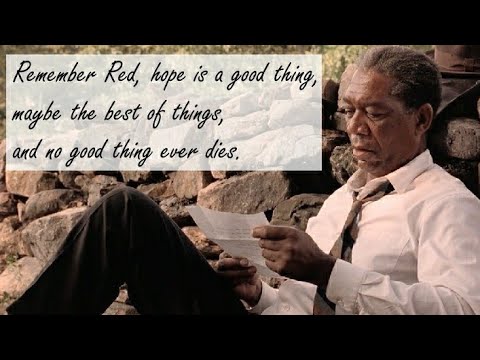
Writing is always an act of hope.