Chapter 9 Required Materials and Tasks
Chapter 9 Required Readings and Tasks: Social Constructionism
- Your Teacher Story First DRAFT DUE
- “Cognition, Convention, and Certainty: What We Need to Know about Writing” by Patricia Bizzell: Pre/Text: A Journal of Rhetorical Theory 3:3 (Fall 1982): 213-43.
- “Collaboration and the ‘Conversation of Mankind’” by Kenneth A. Bruffee: College English, Vol. 46, No. 7 (Nov., 1984), pp. 635-652
- Requires login via IUP account
- “Inventing the University” by David Bartholomae: Journal of Basic Writing, Vol. 5, No. 1, 1986
- “Collaboration and Concepts of Authorship” by Lisa Ede and Andrea A. Lunsford: PMLA, Vol. 116, No. 2 (Mar., 2001), pp. 354-369
- “A Pedagogy of Mulitliteracies: Designing Social Futures” by The New London Group: Harvard Educational Review: April 1996, Vol. 66, No. 1, pp. 60-93.
Chapter 9 Class Activities
Lesson Objectives
- To consider how Collaborative Learning Theory and Social Constructionism have shaped the Composition Field
- To reflect on how to effectively make use of collaboration when teaching composition
Collaboration in Action
- Video: The Biggest Global Collaboration Song EVER (Probably)
- Posted by Brett Domino
- Break at 3:50; then jump to 5:00 for ending
- The song contains 54 musicians using almost as many instruments, culled from 100s of additional entries
- The individual musicians did not get to hear each other, but they did have to play with a specific tempo and key
- In the words of one YouTube viewer, Graham Haslett: “I’m not one for exaggerating, but this is Quite possibly the single greatest thing ever put out on YouTube”
- This composition, or mashup, could really only be created through collaboration
| The Theory of Collaborating | The Allure of Going Solo |
 |
 |
- Team Task
- Write a group road trip story
- Your story should be 3-5 paragraphs long
- Make the story a cliffhanger (leave the ending unfinished)
- Full Class Discussion
- Share your team’s story
- Lori Ann S. Woods—Alive inside: Transformation, capital, and zombies in the composition classroom (Readers: Dr. Dana Driscoll and Dr. Scott Moore)
- Discussion Questions: Assessing Collaboration
- Can collaborative writing be a joy?
- What was similar and different about this story writing from other group projects you have done?
- How would being graded on this activity change it?
- Who owns this story? Why does ownership matter to us?
- If an editor tells a scholar how they have to rewrite 10% of an article, who’s article is it? What if the editor makes the novelist rewrite 60%? Who owns the article then? Who owns any writing?
- How do you think our focus on individual assessment limits education? Should we be grading people on how successfully they are able to work together?
- We will get to this more later in the semester
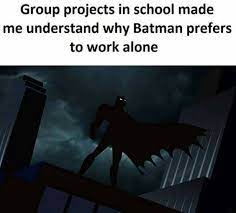
- Collaboration is at the heart of how comic books are produced
- The theory of Comic Book Pedagogy argues that collaborative writing has been an under used/under valued pedagogical tool
- This theory is grounded on a belief in the social construction of knowledge
- (It’s also why I included the Batman meme above! 🙂
The Social Turn in Composition
- “Cognition, Convention, and Certainty: What We Need to Know about Writing” by Patricia Bizzell
- Pre/Text: A Journal of Rhetorical Theory 3:3 (Fall 1982): 213-43.
- Bizzell: “Inner-directed theorists seek to discover writing processes that are so fundamental as to be universal” (p. 215)
- Bizzell: “In contrast, outer-directed theorists believe that universal, fundamental structures can’t be taught; thinking and language use can never occur free of a social context that conditions them” (p. 217).
- Bizzell argued that we need to help students learn the conventions of discourse communities in order for them to be able to write effectively
- Overall, the social turn in composition pedagogy represented a move for increased recognition of rhetorical discourse communities, the social, cultural, and political forces that influence the classroom, and the ways that ideology affects writers and the writing classroom.
Discourse Communities
- Bartholomae, David. “Inventing the University.” When a Writer Can’t Write: Studies in Writer’s Block and Other Composing Process Problems. Ed. Mike Rose. New York: Guilford, 1985. 273–85.
- Berlin, James A. “Rhetoric and Ideology in the Writing Class.” College English 50.5 (1988): 477–93.
- Elbow, Peter. “Being a Writer vs. Being an Academic: A Conflict in Goals.” College Composition and Communication 46.1 (1995): 72–83.
- Harris, Joseph. “The Idea of Community in the Study of Writing.” College Composition and Communication 40.1 (1989): 11–22.
- Porter, James E. “Intertextuality and the Discourse Community.” Rhetoric Review 5.1 (1986): 34–47.
Social Constructionism Theory
- What Is Social Constructionism? by Tom Andrews
- Grounded Theory Review: An International Journal. Iss. 1, June 2012, Vol. 11
- “Constructivism” means individuals construct reality
- “Social constructionism” means reality is created through dialogue and interactions among people
- Andrews offers this definition of “social constructionism”: “In attempting to make sense of the social world, social constructionists view knowledge as constructed as opposed to created….social constructionism is concerned with the nature of knowledge and how it is created…Society is viewed as existing both as a subjective and an objective reality. Meaning is shared, thereby constituting a taken-for-granted reality. Grounded theorists understand knowledge as beliefs in which people can have reasonable confidence; a common sense understanding and consensual notion as to what constitutes knowledge.”
Lev Vygotsky: Language Learning Is Social
- Vygotsky’s research lends support to Social Constructionism Theories
- Vygotsky found that thought is really internalized social speech; we hear others speak and then internalize that dialog
- Thus we are primed to learn through social interaction
- This led Vygotsky to develop his theory of the Zone or Proximal Development (ZoPed): We learn best from a slightly more capable peer
- Vygotsky, Lev, Mind in Society: The Development of Higher Psychological Processes (Published 1978)
- Vygotsky, Lev Thought and Language (MIT, 1986)
- PowerPoint: Introduction to Vygotsky’s Theories
- Everson, Barbara J. “Vygotsky and the Teaching of Writing,” The Quarterly Vol. 13, No. 3 (1991)
- Everson argues that Vygotsky’s theories
Collaborative Learning Theory
- “Collaboration and the ‘Conversation of Mankind’” by Kenneth A. Bruffee: College English, Vol. 46, No. 7 (Nov., 1984), pp. 635-652
- “Collaboration and Concepts of Authorship” by Lisa Ede and Andrea A. Lunsford: PMLA, Vol. 116, No. 2 (Mar., 2001), pp. 354-369
- Recommended: “Collaborative Pedagogy” by Rebecca Moore Howard: Tate, G., Taggart, A. R., Schick, K., & Hessler, H. B. (2014). A Guide to Composition Pedagogies. New York: Oxford University Press, 54-70.
Discussion Questions: Collaborative Learning
- Should we have students engage in collaborative writing? Why or why not?
- If we do ask students to write collaboratively, how can we make the process work better?
- Is peer review collaborative learning? Why or why not?
- How can we better teach the importance of collaborative writing?
A Collaborative Dissertation
Although the field of composition has been very interested in collaboration for a long time, the genre of the dissertation has resisted collaboration, at least in the humanities. In 2015, however, two students in what was then called IUP’s Composition and TESOL Program wrote what was essentially a collaborative dissertation. They were required to write over 50% of their individual texts themselves, which they did. However, the rest of the text they co-wrote. And of course they collaborated on the rest of the writing too. These 2 dissertations, taken together, trace ideas about collaborative writing and also issues of resistance to the question of fully co-writing a dissertation:
- Mangini, Laura M. (2015). Collaborative dissertations in composition: A feminist disruption of the status quo. (Passed with distinction.)
- Mangini, Sabatino M. (2015). Composition and the cooperative dissertation study. Our collaborative resistance. (Passed with distinction.)
Multiliteracies and Multimodality
- Collaborative learning naturally leads toward work with technology, which is inherently interactive and multifaceted
- Our thinking about multimodality begins with the work of the New London Group in 1996
- “A Pedagogy of Mulitliteracies: Designing Social Futures” by The New London Group: Harvard Educational Review: April 1996, Vol. 66, No. 1, pp. 60-93.
- Howard Gardner, Multiple Intelligences
Peer Review: Your Teacher Story First DRAFT
- Dr. Pagnucci will offer a word about story privacy.
- Pair up with another student in the course.
- Trade Your Teacher Story First DRAFTS.
- Read the paper and note your thoughts, comments, and questions about it.
- Discuss the paper with your partner.
- Revise Your Teacher Story for upload next class day.
Chapter 9 Optional Materials
Online Collaborative Spaces: Wikis
- Wikis are one of the most interesting technologies for collaborative writing
- Video: “Wikis in Plain English” by Lee LeFever
- Wikipedia (online collaborative encyclopedia)
- Article: “How Today’s College Students Use Wikipedia for Course-related Research” by Allison J. Head and Michael B. Eisenberg
- The WikiBib Project
- The CAL Program is piloting a new student assessment
- Please view the TED talk below and compose a 300-400 word summary of it
- TED Talk–Carol Dweck: The Power of Believing That You Can Improve
- This 10-minute TED talk reports on a qualitative study of how children coped with challenge, which led to her theorizations of the “growth mindset” (the idea that we can grow our brain’s capacity to learn and to solve problems)
- This task should take you no more than 1 hour to complete
- Please upload your summary in D2L by next week’s class