Reflective Practice Teaching
There is a proud tradition of teachers studying their classrooms to learn ways to better help their students. Reflecting on pedagogical practice can be traced all the way back to work of seminal educational philosopher John Dewey. When Teacher Scholars reflect on their pedagogy and practice it fosters their self-growth and development.
The Boyer Model of Scholarship
- Boyer, Ernest L. (1990). Scholarship reconsidered: Priorities of the professoriate. (PDF), Carnegie Foundation for the Advancement of Teaching.
- Smith (2021) describes Boyer’s model as follows: “An integrated approach to education and learning, encompassing four main themes; Teaching and learning, integration, application, and discovery (Boyer, 1990). Boyer used this model to challenge and reflect on the pre-existing “functions academics are expected to perform” (Boyer, 1990, p. 2)
- Boyer, E. L. (1996). From scholarship reconsidered to scholarship assessed. Quest, 48(2), 129-139.
- Houdyshell, Michale, Sughrue, Jennifer, Carothers, Doug, & Aydin, Hasan. Is Boyer’s Scholarship Reconsidered still relevant: A case study of a college-wide professional learning community. Journal of the Scholarship of Teaching and Learning, Vol. 22, No. 1, March 2022, pp.113-137. doi: 10.14434/josotl.v22i1.31185
New Models for Scholarship
- The Teacher-Scholar Model at Cal Poly University

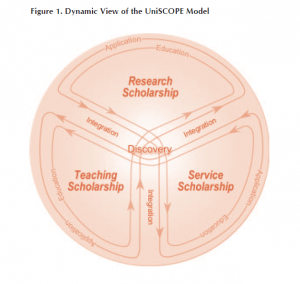
- Hyman, Drew, Gurgevich, Elise, Alter, Theodore, Ayers, John, Cash, Erskine, Fahnline, Donald, Gold, David, Herman, Robert, Jurs, Peter, Roth, David, Swisher, John, Whittington, M. Susie, & Wright, Helen. Beyond Boyer: The UniSCOPE Model of Scholarship for the 21st Century. Journal of Higher Education Outreach and Engagement, Volume 7, Numbers 1&2, p. 41, (2001-02)
- Rumsey, A. (July 2011, “New-model scholarly communication: Road map for change,” Scholarly Communication Institute 9. University of Virginia Library.
Reflective Practice
- Dewey, John. Democracy and education.
![Democracy and Education [with Biographical Introduction]](https://m.media-amazon.com/images/I/613jxGXuJLL._AC_UL400_.jpg)
- Dewey, John. The school and society.

Teacher Scholarship
- Goswami, Dixie, Lewis, Ceci, Rutherford, Marty, & Waff, Diane. (2018). On Teacher Inquiry: Approaches to Language and literacy research.

- Goswami, Dixie, & Stillman, Peter (Eds.). (1986). Reclaiming the classroom: Teacher research as an agency of change.

- Tripp, David. (2011). Critical incidents in teaching (classic edition): Developing professional judgment. 1st ed. Routledge.

Narrative Inquiry Research
One of the key ways that Teacher Researches have studied their classrooms is through the narrative inquiry approach.
Narrative Inquiry Books
Here are some of the key books in the area, starting, naturally with Dr. Pagnucci’s book on narrative:
Living the Narrative Life: Stories as a Tool for Meaning Making
- Pagnucci, G.S. (2004). Living the narrative life: Stories as a tool for meaning making. Portsmouth, NH: Heinemann Boynton/Cook.
- Sample Chapter–Part 5: Dear Class, Notes, and Telling Work Legends (PDF downloadable file, 429 KB)
Seminal Books on Narrative Inquiry
- Connely and Clandinin. Narrative Inquiry
- Schaafsma and Vinz. On Narrative Inquiry
Narrative Resources
In addition to these key books, here are some other useful resources: